About this blog

This blog looks at how families express themselves and provides practical suggestions for improving communication.  Of course, "effective" and "improving" are value-laden terms, so while you may not agree with each of my suggestions, I do hope you'll keep stopping by to find the nuggets that work for you and those you love.  As you find ideas of value, please share this page with others.

NOTE: On the right-hand side of this page, click on "Follow Me On Twitter" and you will receive an update each time I post to this blog.  Also, click on "Receive Our 'Effective Family Communication' Newsletter" and you'll be added to our mailing list.


Monday, June 13, 2011

Indirect Communication - Why I love weddings

Nine days ago we attended our first (only?) wedding of the summer.  We’re at a stage of life where we attend fewer weddings (our friends aren’t getting married, our kids aren’t yet getting married, and our kids’ friends aren’t getting married), but when we do I enjoy them because of one simple fact.  While there are traditions that many weddings incorporate, each wedding is a unique expression of the personalities of the participants (often particularly the bride) – a form of indirect communication.

This wedding was of two young adults who grew up outside the US, one in Ecuador and one in Congo.  IMG_2266So there was a beautiful duet in Spanish and scripture reading in French.  The wedding was outside in Georgia – hot to those of us used to living in the north, but comfortable to those who grew up near the equator (the equator runs through both Ecuador – hence the name – and Congo-Brazzaville).  The vows were written by the bride and groom and instead of wedding cake there were pies.  Square dancing and corn hole were among the activities.  It was a spirited celebration that told you a lot about Travis and Kaylyn.

So now that wedding season is upon us, see what you can learn about the bride and groom from their indirect communication – the structure and setting of the ceremony, as well as the activities that follow.  Listen with all five senses and see how much better you know the new couple when the day concludes.

Tuesday, May 24, 2011

Ages and Stages: Bob Dylan and the Iditarod

Happy Birthday, Bob!

Bob DylanBob Dylan is 70 years old today.  Many of you know that Bob is one of my favorite musicians.  It’s difficult to explain and impossible to defend – yes, I’ve heard his voice.  It has something to do with his use of words, even in the songs where I really can’t decipher what they might mean.

My dad talks about “ages and stages.”  It always helps to remind me that not everything has to be accomplished today – that there are different stages in life and the goal is to find meaning where you are today.

Dylan certainly has had stages in his career and he continues to defy easy categorization.  He’s done folk, country, rock, folk-rock, traditional, and gospel.  Somehow he has managed to find an audience for each stage.

I’ve been watching a 6-part series on Netflix about the Iditarod – the dogsled race across Alaska covering more than 1,100 miles with 20-plus checkpoints along the way.  One of the competitors made the point that at the end it isn’t whose team is getting faster but whose team is slowing down less.  There are stages to the race and those who win know how to manage their teams during each stage.

Recently Judy and I were talking about the appeal of the empty-nest stage,but we’re not there yet and likely won’t be for many years to come.  So we’re finding meaning where we are today – celebrating the fullness of our nest.

May you be happy for your age and stage!  That’s my wish for Bob.

Tuesday, May 17, 2011

Failure must be an option

“Failure is not an option.”  If you are the surgeon repairing my heart, I trust that is exactly your attitude.  But when parenting, we’ve got to be open to a different mantra.

Biographies, business self-help books, and VH1 retrospectives often portray failure as a significant opportunity for learning and growth – someone rises to prominence, fails, and then climbs back, only this time with a greater depth of understanding and meaning to what they do.

Somehow as parents we read those books, hear those stories, and yet we go to great lengths to make sure our children avoid failure.  So it is with some trepidation that I tell you the following story.

Recently our oldest turned 15 1/2.  Normally we don’t acknowledge half birthdays, but this meant that he qualified to apply for his temporary driver’s permit.  I thought we had communicated to him that he needed (was required) to read the handbook before taking the written exam.  On the way to the testing station, which is not close to our home, I asked him some general questions to which he did not seem to know the answers.  I asked if he had read the book and he said, “Some of it.”  He chose not to read most of it because he didn’t see the relevance to his anticipated experiences while driving.  For example, what 15-year old needs to know rules about child safety – he isn’t a child and he has no children.  I tried to point out that passing an exam like this wasn’t about what he believed to be applicable to his life, but about what the state requires him to know.  Anyway, I almost laughed out loud (perhaps I actually did) when I heard the woman behind the counter say, “You can always come back and try again tomorrow,” as my son got up from completing his exam.

On the way home we didn’t talk a lot (which is unusual for the two of us).  I told him I was feeling conflicted – happy he hadn’t passed without studying, but sorry for him because I knew he was excited to receive his permit.  I told him I would be happy to drive him to retake the exam after he had read the book.  About three weeks have passed and I’m still waiting.

FailureWe don’t want our children to fail.  If it is about our pride as parents and that ongoing competition with other parents through our children, then we need to grow up.  If it is about not having to take the time to redo something later, we need to be more patient.  If it is about sparing our children the pain of failure, then we need to take a longer view of their lives – they’re going to fail and experience pain.  Learning how to deal with those emotions while under our supervision is better than experiencing them for the first time while on their own and after years of being taught that they just don’t fail – that failure is not an option.

We say we believe that failure is a great opportunity for learning – we just want to gain our education in some less painful way.  The best / hardest part of the experience with my son was that he was one point from the threshold needed to receive his permit.  Had he gotten that one additional point he would have concluded, once again, that studying was not necessary in order to get by – he really didn’t need to know anything about child safety.  But earning a 29 reminded him that failure is possible and that one should then ask “Why did I fail?”, “What can I learn from this experience?” and “How can I keep this from happening again?”

Failure must be an option because avoiding it at all costs means avoiding opportunities to succeed and experience life’s meaning.

Monday, May 16, 2011

Games Families Play–6 Games I Recommend

We are a game-playing family.  While we enjoy some of the old standbys, we’ve gotten hooked on the game store variety that are more expensive, but worth the investment.  When you consider what it costs to take a family of five to see a movie, you can easily justify the cost of a board game that you’ll play for years.

Here are six winners I recommend based on the following criteria:

  • Appropriate for middle schoolers through adults
  • Winners must be strategic and not just lucky
  • High repeat playability – they don’t grow old quickly
  • Typical games last one hour or less
  • Worth the investment
  • Don’t use dice

1) Ticket to Ride – Europe (click to follow link)
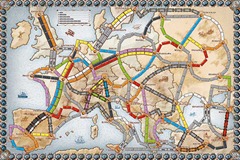
Ticket to Ride - EuropeThis is the game that got us hooked.  You build train routes across Europe while avoiding your competitors who may try to occupy the same sections of track.  Buy the Europa 1912 Extension to increase the number of routes and make the game less predictable.

Strategy (5 being significant strategy / 1 being complete luck): 3.5

Repeat playability (with 5 meaning it never gets old): 4.5

2) Metropolys (click to follow link)

MetropolysI bought this used online and am loving it.  You bid to place your buildings strategically throughout a city – all the while working to accomplish your secret objectives.  The expert version (part of the original game) adds interesting twists that make it more difficult to discern and, therefore block, your opponents’ secret objectives.

Strategy: 4.5

Repeat playability: 4.5

3) Carcassonne (click to follow link)
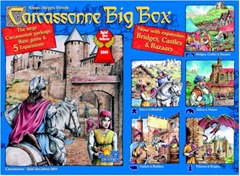
Carcassonne Big Box 3You use tiles to build cities, complete roads, farm pastureland, and much more.  We purchased the Big Box 3 which contains the original game and five of the most popular extensions to the game.  I would also recommend buying the River II extension.  You can play the original game alone or with as many extensions as you like.  The more extensions, the longer the game takes, but even with all of the extensions in the Big Box you are looking at about 90 minutes.

Strategy: 3.5 (luck in drawing tiles, but strategy in how you place them)

Repeat playability: 4.5

4) Settlers of Catan (click to follow link)

Settlers of CatanYou build settlements and cities while paying for everything in commodities (sheep, wood, bricks, grain, ore) that you earn or trade for with your opponents.  Good game with lots of variability.  I have two gripes: 1) Starting position in the game significantly influences the final outcome, and 2) You use dice – which exacerbates the feeling of chance even if it is no more random than drawing tiles in Carcassonne.

Strategy: 3

Repeat playability: 3.5 (4.0/4.5 if you ask my kids)

5) Hey, That’s My Fish! (click to follow link)

Hey, That's My Fish!A great game for brighter young children through adults – you collect fish by moving your penguins around an ice flow that gets smaller with each turn.  This is a quick game that is lots of fun.  The strategic principles remain constant but the layout changes with each gameplay.

Strategy: 4.5

Repeat playability: 4.5

6) Buzz Word (click to follow link)

I include this one for my wife.  This is the perfect party game – fast moving, laughter inducing, encourages conversation between rounds, can last as long as needed.  You are given a key word (“buzz word”) such as “apple” and then you have to respond to clues for 10 common words or phrases containing the word “apple.”

Strategy: Not really the right criterion for this one – more a matter of word association and recalling bits of general knowledge than being strategic

Repeat playability: 4.0

If you find you want to know more – I recommend going to Board Game Geek (click to follow link) for detailed information on these and thousands of additional games.

Let the games begin!

Monday, May 9, 2011

Mother’s Day–Celebrating Motherhood, Whatever Its Form

Yesterday we celebrated Mother’s Day and had a great time together as a family.  Our day began at church and, as is typical, our congregation honored mothers.  As one of the pastoral staff recognized various types of women (mothers of biological children, mothers of adopted children, women unable to be mothers, mothers who have had a child die, mothers who have given a child up for adoption), I found myself wondering, “When did Mother’s Day become so complicated?  It used to be so simple.”

Obviously a goal was to make Mother’s Day accessible to women who may find it painful or exclusionary.  Not being a woman, I don’t know if the attempt was successful.  My guess is that there were women present who appreciated the broader view and the recognition of their various relationships to this celebration.

Mother's DayThen I found myself reading the closing article of the latest edition of Sports Illustrated (May 9, 2011).  The article, “A Mother’s Day Gift” by Phil Taylor, is the story of Joe Riddle and Ellen Durfey-Wright.  It gave me a deeper appreciation for our congregation’s more complex view of Mother’s Day.  It reminded me again of the healing power of love and the elastic nature of family.  I’d encourage you to click on the link and read the story for yourself.

To all mothers – we are thankful for your contributions to our lives.

To my mother – I will love you always!

Tuesday, May 3, 2011

The couple as family–keep talking to keep your family strong

Around the time that we had our first child, Judy and I read a book that said we were a family whether we ever had children – that children don’t make you a family.  The concern, I believe, was that you should not create a child-centered family where the child became the focal point of decisions and control.  Instead, you invite your children into your existing family with its beliefs, preferences, guidelines, traditions, etc.

Last Thanksgiving our eldest was away from us on a school trip.  This spring I took him to look at colleges.  Both events were a reminder that there is a day coming when we will be a family after having had children.  Not that our children won’t be part of our lives once they move out of our home (and not that they will move out of our home as quickly as we now imagine), but Judy and I are a family that needs to continue in the absence of our children as well as in their presence.

CoupleTo that end, I encourage you to find ways to build regularly occurring communication into your marriage.  Judy and I often run errands, wash dishes, or walk the dog together – whatever it takes to have conversation between the two of us.  Just as many couples only feel that they are a family once they have had children, so many couples feel they are only a family when the children are around.  The couple forgets that the two of them form a family and that they need to build and preserve that family through all stages – before children, while children are in the home, and after children have left the home.

Don’t preserve your family for the sake of the children.  Celebrate your family by choosing to love one another.  Express that love through frequent and intentional conversation.  Keep talking – keep your family strong and healthy.

Friday, April 22, 2011

The three Ps of education

A friend of mine reminded me the other day of a talk I had given way back when.  The gist was that I was challenging incoming adult students to take the appropriate view of their educational process in order to gain the most from it.  I used alliteration to make it more memorable – evidently it worked for my friend.  I, on the other hand, had to be reminded.

Perfectionism – The belief that there is an ideal, that the ideal is achievable, and that the ideal ought to be achieved.

This is slow, painful death.  It has been known to result in the unfortunate situation where a student earns an “F” for unfinished work that is being perfected rather than a “B” for completed work that is imperfect.  Our adult degree completion program had students who failed to graduate because they were perfectionists who could never bring themselves to hand in their final projects.

Procrastination – The belief that there is always more time even as the deadline races toward you like a bullet train.

This is speeding toward an immovable object, hoping that it will disappear, only to be obliterated.  More students have failed assignments because of procrastination than will ever fail due to inability.  Procrastination has many sources (one, of course, is perfectionism), but the end result is the same, work is submitted that is inferior to what it could and should have been.  I’ve had many students tell me that they do their best work under pressure.  There may be some truth to that – the mind focuses as the deadline approaches and they are able to concentrate their attention and effort.  But it is only a partial truth.  I know from my own experience how many times I have stood to give a presentation and realized that if I had just given more thought to the illustration I was using it would have been so much more effective.  Bottom line: One cannot be assured that creativity will flow, or that printers will work, at the last minute.

Pragmatism – The realization that reality trumps what might have been.

This is a compromise between our striving for the ideal and our desire to avoid failure.  Pragmatism is often treated like something that is lesser, something to be avoided.  Compared with perfectionism and procrastination, pragmatism gets things done.  Pragmatists graduate, on time, often with better GPAs than anticipated because, at the end of the day, they were committed to finishing more than they were committed to reaching the unreachable or to being waylaid by distraction.

Michael LeffAll of this grows out of personal experience.  When I entered my PhD program at Northwestern, I was assigned an up and coming star among the faculty as my advisor.  He was a charismatic educator and a reminder of what we, as incoming graduate students, were meant to become.  Thankfully I asked around and found out that none of the students assigned to work with him had completed their dissertations.  He was a perfectionist who was always calling upon them to revise their work.  I requested a new advisor and was assigned to an aging star with decades of experience guiding doctoral students.  He made it clear from the start that he wanted to see me graduate and that the goal was to get things done.  I went through a period of nine months where I was getting nowhere on my dissertation and so I avoided him.  When I reengaged, he steered me back toward a pragmatic view of my work and a commitment to completion.  So, once again, I thank the late Dr. Michael Leff for teaching me the value of educational pragmatism.

(For the record, this is not a defense of philosophical pragmatism and its view of truth.  That is another topic for another day.)